After years of holding space for women as a somatic practitioner, I’m noticing something that’s becoming increasingly present in my work.
Women are not merely busy. We are carrying a bone-deep, nervous-system-level exhaustion.
Even when we love our work, our families, and our communities, we often live in an undercurrent of overwhelm. A sense of being slightly unmoored, stretched thin across invisible expectations, and wondering why life feels so heavy at times.
And when I pause and look at the wider architecture of the world we live in, my first response is always the same: no wonder.
No wonder we feel burnt out, overwhelmed, and a little lost at times. We are trying to live and lead as relational, cyclical, embodied human beings inside systems designed for linearity, extraction, hyper-individualism, and perpetual productivity.
When Did We Start to Carry It All Alone?
Over the last few years, words like matriarchal leadership have begun circulating more widely in women’s spaces.
On the surface, it sounds appealing. Yet when I say that phrase aloud to women in midlife particularly, I often notice their shoulders collapse a little - almost as if in defeat.
Underneath the inspiration and the hope, a question immediately emerges: "Does this mean I have to take care of even more?"
I understand that instant reaction intimately. I feel it when I’m already exhausted and something else is asked of me that I know I don’t have the capacity for.
In our culture, particularly in the western world, it’s easy to confuse matriarchy with martyrdom.
Through a patriarchal lens, we might imagine the matriarch as the exhausted woman at the head of the table soothing everyone’s emotional tone, keeping everything ticking along, anticipating every need, and holding the entire family, team, or community to the point of exhaustion.
That is not matriarchal leadership.
It is isolation and self-sacrifice disguised as generosity and kindness.
The Wisdom of Matriarchal Societies
When we become curious about cultures described as matriarchal by scholars such as Dr. Heide Goettner-Abendroth (from the Mosuo in southwest China to the Haudenosaunee Confederacy and the Minangkabau of West Sumatra) we find something radically different from the models many of us live within.
Matriarchal societies are not "patriarchy flipped on its head" with women standing alone at the top of a pyramid, which in essence, would simply be a different gender dominating the other.
Instead, they are communities built around tending life together, where women and men stand side by side, each holding complementary roles that support the whole village moving in harmony.
Across these cultures, we find different expressions of a few deeply human ways of being that seem to have gotten forgotten in our current ways of life:
Everyone has a place and a voice: Women and men work together, each fulfilling unique roles. Decisions are made through deep listening and shared council, and every role is recognised as essential to the whole.
The whole village mothers: Raising children and caring for each other never rests on one woman’s shoulders alone. The entire community mothers the children and wraps around the mothers, so care is shared and flows where it’s needed.
Elderhood is revered: Growing older is not seen as fading into irrelevance. Elders, especially older women, are valued for their lived wisdom, their experience and their perspective. They are not left to the side, but cared for by younger generations and the wisdom is passed along.
Leadership is rooted in service, not self-interest: It isn’t about serving your own ego and interests but about being in service to the wellbeing and thriving of the community, the land, and the generations to come.
Giving and receiving: Care, time, and resources circulate based on what people need and have the capacity to give. No scores are kept. Everyone tends the community and everyone is tended.
The Earth is treated as a living mother: The land is not seen as something to be owned or a resource to be endlessly extracted from. The Earth is seen as the great mother and honoured as such. Life moves in natural seasons both literally and figuratively and all seasons - including fallow ones - are recognised as parts of daily life, not inconvenient interruptions to productivity.
Ordinary life is seen as sacred: Spirituality is woven into daily life. Cooking, gathering, birth, grief, and the small acts of daily life are seen as sacred acts of devotion.
At their heart, what we see is that matriarchal societies have a different architecture. They aren’t the pyramids of power we are used to in the western world, but rather they function like a circle where every person holds part of the whole.
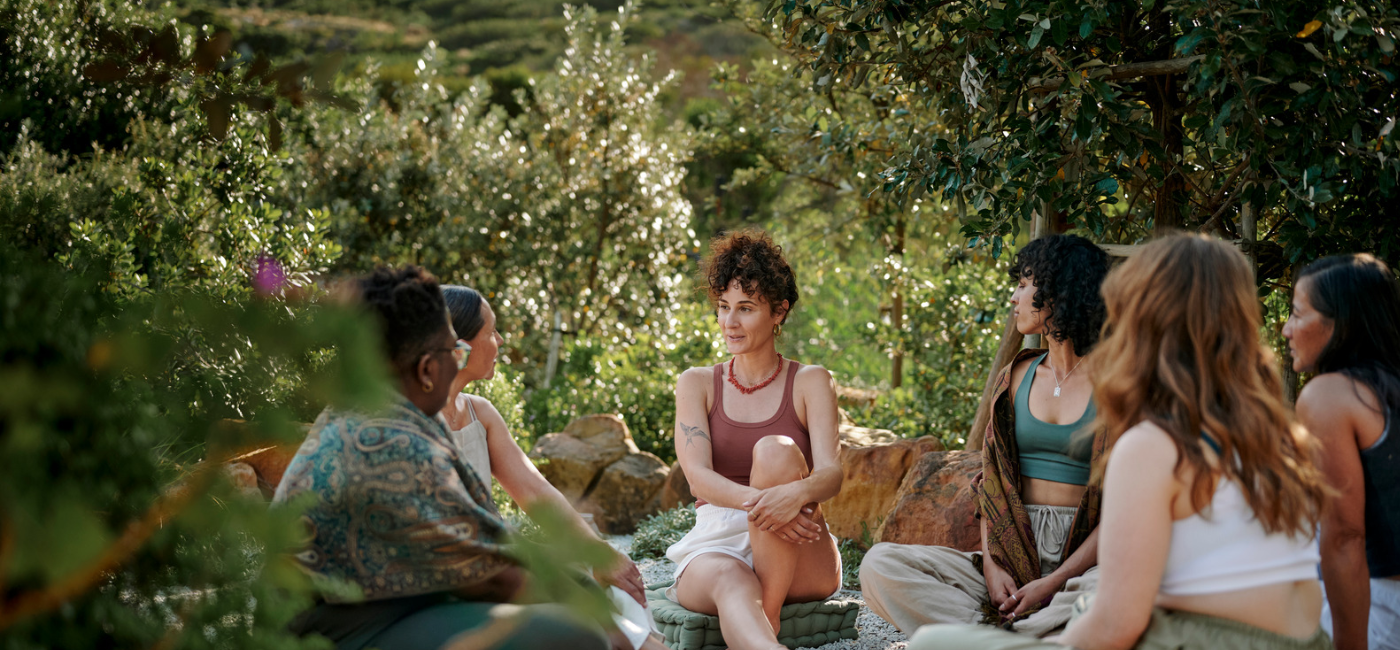
A matriarchal leader isn’t someone who carries everything for everyone. We can imagine her instead as tending the fire at the centre, with everyone seated around the circle bringing wood.
Remembering an Older, Wiser Blueprint
For me, reading about these matriarchal ways of living felt less like learning something entirely new and more like remembering something my body already knew.
It’s something I’d already explored organically through my work around embodied feminine leadership - without having explored matriarchal societies.
What we sense intuitively in our bodies when we slow down and listen makes so much sense. No wonder we sometimes feel like we are living counter-current, and out of flow.
Our bodies and nervous systems are remembering an older, wiser blueprint.
Of course, we cannot dismantle centuries of internalised and real-life patriarchy overnight. But what we can do is begin reweaving small threads of matriarchal wisdom back into the fabric of our ordinary days.
This isn’t about learning how to better fit into the current systems of power that deplete and extract. It’s about gently transforming the way we live.
A Line of Inquiry for Your Body Today
If you’d like to reflect on what this might mean for you, I invite you to ponder these reflection prompts:
What feels heavy in my life right now simply because I am trying to carry it alone?
When I imagine myself sitting in a circle where everyone 'brings wood to the fire', what happens in my body?
What is one small place this week where I can invite a little more reciprocity?
We might not be able to singlehandedly transform the society we live in, but we can bring small threads of this wiser blueprint into our everyday life.
Embodied feminine leadership, and moving out of survival and over-functioning into more grounded, nourishing, and expansive ways of being, is part of what I teach inside The Wisdom Within™ Somatic Practitioner Training. You can find out more here.
You might also be interested in:
Overcoming Feminine Burnout: How to end the perpetual quest towards being enough
Finding Inner Rest in an Unrested World
Burnout Begins Long Before it Happens : When Women Don’t Have a Village
The Edge of Burnout: Listening to the Body Before It Shuts Down